Prototyping TransitionScapes

Interactive Installations / Research

Key Takeaways

lijstje van dingen

Revealing the invisible social dynamics powering the energy transition

The transition to sustainable energy depends not only on technology, but on people. As creative partner within the Transition-Scapes research programme of the Amsterdam University of Applied Sciences, we collaborated with researchers to explore how interactive experiences can strengthen public participation in the energy transition.

Together we developed two very different prototypes. One helps existing communities recognise their own collective strength. The other gives future residents a voice in designing neighbourhoods that do not yet exist.

Technology as an instrument for participation

Scientific research helps us understand complex transitions. Experience design helps people become part of them. Throughout Transition-Scapes, we collaborated closely with researchers to develop interactive frameworks that translate abstract social dynamics into shared experiences. The resulting prototypes, methods and design principles enable communities to better understand their own role in the energy transition, while providing institutions with richer ways of listening to the people they serve.

Prototype 1: Making Community Strength Visible

Huis van de Toekomst is a community hub in Rotterdam that helps residents tackle energy poverty together. By bringing together local initiatives, practical solutions and neighbours, it supports people in reducing energy costs while building a stronger community around the energy transition.

Located in one of the Netherlands’ most socio-economically challenged neighbourhoods, dozens of local initiatives work every day to strengthen the community. Yet much of their collective impact remains invisible, both to residents themselves and to the institutions that support them.

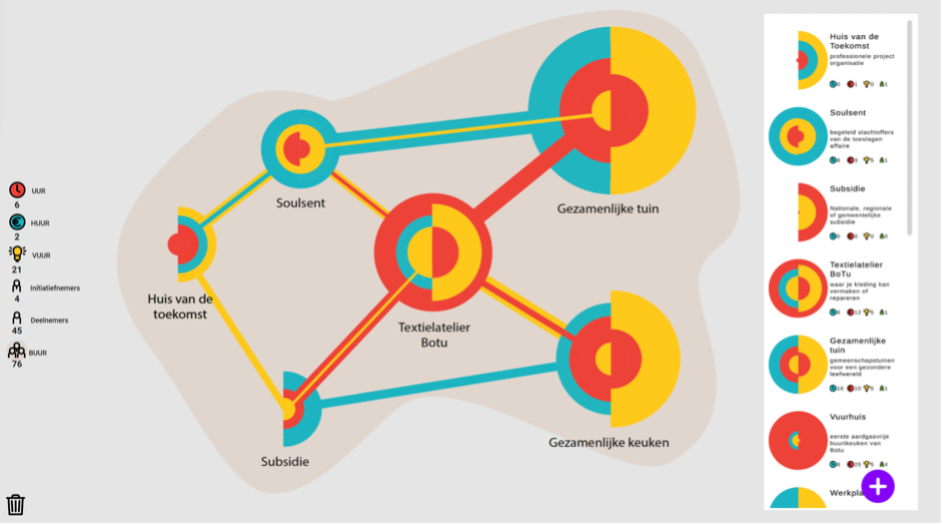
To make these often unseen relationships visible, we developed an interactive simulation that reveals how local initiatives strengthen the social fabric of the neighbourhood over time. Rather than visualising only energy or money systems, the prototype maps the community infrastructure behind the transition, showing where initiatives reinforce one another.

Visualising Collective Strength

Every community initiative begins with someone who decides to contribute. Whether they organise a repair café, maintain a community garden or teach language classes, people invest their own time, knowledge, passion and commitment to strengthen their neighbourhood. Some initiatives also require financial resources, but many are driven by something less tangible: the belief that together they can make a difference.

Each initiative generates value in return. A language course increases employment opportunities, a bicycle repair workshop improves affordable mobility, and a community garden provides fresh produce while bringing neighbours together. These benefits often extend far beyond the people directly involved.

.

To understand these relationships, we developed an alternative value framework that goes beyond money and time. By combining financial investment, personal motivation, community strength and time, the interactive tool reveals the web of interdependencies between initiatives. It shows how small projects create the trust, knowledge and participation needed for larger initiatives to emerge, allowing communities to grow stronger over time.

The visualisation serves two purposes. First, it encourages contributors by making visible how their individual efforts enable many others. Second, it gives community organisations a shared language to demonstrate their collective value to municipalities and housing corporations, helping them advocate for the support needed to continue growing.

Alternative value system

The hardest challenge was that not everything that matters can be expressed in money or time. Communities are also built on trust, motivation and the willingness to help one another.

To visualise these less tangible forms of value, we co-created a new framework with the research team and the community. By combining financial, temporal, social and personal values, the prototypes reveal how seemingly small initiatives generate the community strength needed for larger collective change.

Prototype 2: Giving Future Residents a Voice

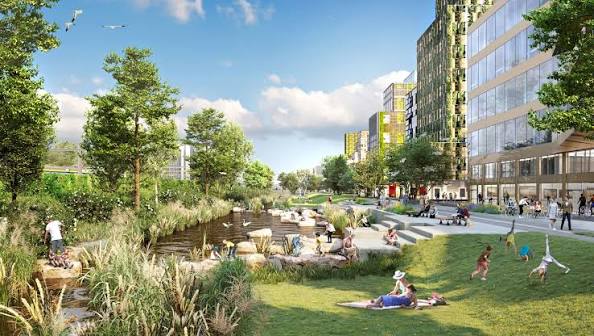
Haven-Stad is one of Amsterdam’s largest urban development projects, transforming former industrial areas into a series of new neighbourhoods where tens of thousands of people will live, work and learn. Many decisions about mobility, public space and sustainable energy systems must be made long before the first residents arrive.

How do you involve future residents in shaping a neighbourhood that does not yet exist? Together with the Transition-Scapes research team, we developed an augmented reality prototype that invites young adults to explore and discuss possible future energy systems before these decisions become reality.

Augmented conversation starter

Rather than presenting a fixed vision, the experience encourages participants to investigate different possibilities together. Using an interactive AR model, they explore how energy could be generated, shared and governed at three interconnected scales: the home, the street and the neighbourhood.

The prototype was designed to support two parallel conversations. For participants, it provides an accessible way to understand the complexity of future energy systems and reflect on the role they want to play within them. For the municipality, it creates a structured way to gather informed feedback from potential future residents and incorporate their perspectives into long-term planning.

Unexpected outcomes

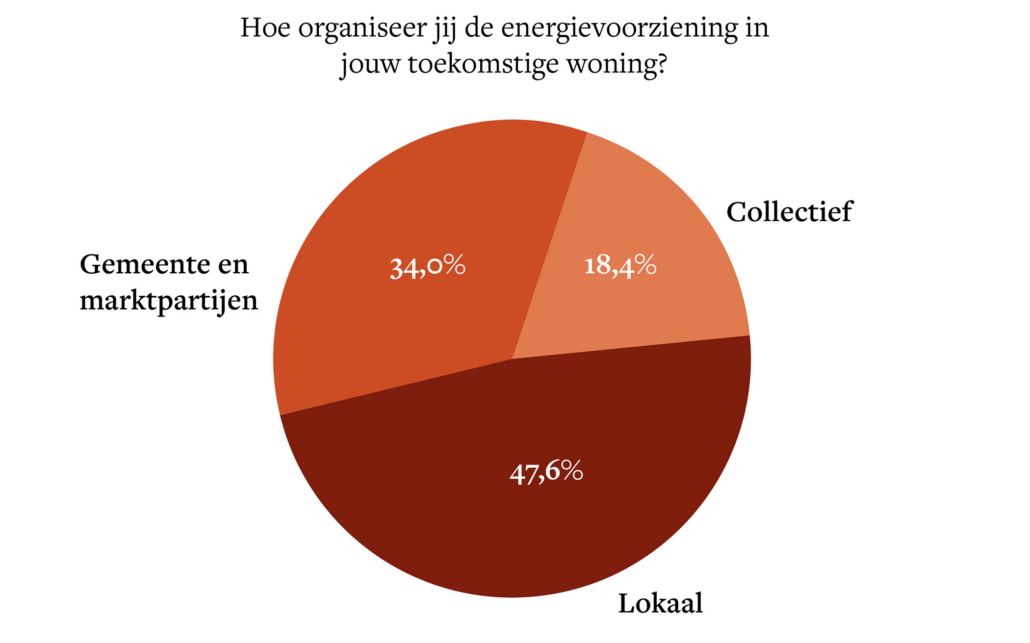
The results were unexpected. Rather than preferring energy provision by the municipality or market parties, almost half of the participants (47.6%) indicated that they would prefer to generate their energy locally. This desire for local autonomy conflicts with the technical reality of a dense urban district, where limited roof space for solar panels and battery storage makes it impossible for buildings to operate fully off-grid throughout the year.

This raises an important question for participatory design: What should designers and policymakers do when participants express preferences that cannot realistically be accommodated? Rather than dismissing these preferences, they can become the starting point for a dialogue about trade-offs, system constraints, and alternative futures. In that sense, feedback is not the end of the design process, but the beginning of the next iteration.

Designing Memory Through Connection

This project demonstrates how design can help people navigate the energy transition. By combining storytelling, co-creation and interactive technology, it enabled future residents to understand complex energy systems and take an informed stance on the future of their neighbourhood.

For SB&CO, this project embodies what we do best: transforming complexity into experiences that empower people. By giving citizens a voice while creating meaningful dialogue between residents, designers and policymakers, it shows how experience design can help people not only understand change, but actively shape it.